«A Meta-Analysis of Randomized Controlled Trials and Prospective Cohort Studies of Eicosapentaenoic and Docosahexaenoic Long-Chain Omega-3 Fatty Acids and Coronary Heart Disease Risk | Elsevier Enhanced Reader». s.d. Consultato 18 giugno 2021.
https://doi.org/10.1016/j.mayocp.2016.10.018.
Albert, Christine M. 2012. «Omega-3 Fatty Acids, Ventricular Arrhythmias, and Sudden Cardiac Death: Antiarrhythmic, Proarrhythmic or Neither».
Circulation. Arrhythmia and Electrophysiology 5 (3): 456–59.
https://doi.org/10.1161/CIRCEP.112.971416.
Alfaddagh, Abdulhamied, Tarec K. Elajami, Hasan Ashfaque, Mohamad Saleh, Bruce R. Bistrian, e Francine K. Welty. 2017. «Effect of Eicosapentaenoic and Docosahexaenoic Acids Added to Statin Therapy on Coronary Artery Plaque in Patients With Coronary Artery Disease: A Randomized Clinical Trial».
Journal of the American Heart Association 6 (12): e006981.
https://doi.org/10.1161/JAHA.117.006981.
Alfaddagh, Abdulhamied, Tarec K. Elajami, Mohamad Saleh, Donya Mohebali, Bruce R. Bistrian, e Francine K. Welty. 2019. «An Omega-3 Fatty Acid Plasma Index ≥4% Prevents Progression of Coronary Artery Plaque in Patients with Coronary Artery Disease on Statin Treatment».
Atherosclerosis 285 (giugno): 153–62.
https://doi.org/10.1016/j.atherosclerosis.2019.04.213.
Bhatt, Deepak L., P. Gabriel Steg, Michael Miller, Eliot A. Brinton, Terry A. Jacobson, Steven B. Ketchum, Ralph T. Doyle, et al. 2019. «Cardiovascular Risk Reduction with Icosapent Ethyl for Hypertriglyceridemia».
New England Journal of Medicine 380 (1): 11–22.
https://doi.org/10.1056/NEJMoa1812792.
Chowdhury, Rajiv, Sarah Stevens, Donal Gorman, An Pan, Samantha Warnakula, Susmita Chowdhury, Heather Ward, et al. 2012. «Association between Fish Consumption, Long Chain Omega 3 Fatty Acids, and Risk of Cerebrovascular Disease: Systematic Review and Meta-Analysis».
BMJ (Clinical Research Ed.) 345 (ottobre): e6698.
https://doi.org/10.1136/bmj.e6698.
Colussi, Gian Luca, Cristiana Catena, Sara Baroselli, Elisa Nadalini, Roberta Lapenna, Alessandra Chiuch, e Leonardo Sechi. 2007. «Omega-3 Fatty Acids: from Biochemistry to their Clinical Use in the Prevention of Cardiovascular Disease».
Recent patents on cardiovascular drug discovery 2 (febbraio): 13–21.
https://doi.org/10.2174/157489007779606158.
Da Boit, Mariasole, Angus M. Hunter, e Stuart R. Gray. 2017. «Fit with good fat? The role of n-3 polyunsaturated fatty acids on exercise performance».
Metabolism 66 (gennaio): 45–54.
https://doi.org/10.1016/j.metabol.2016.10.007.
Djoussé, Luc, Akintunde O. Akinkuolie, Jason H. Y. Wu, Eric L. Ding, e J. Michael Gaziano. 2012. «Fish Consumption, Omega-3 Fatty Acids and Risk of Heart Failure: A Meta-Analysis».
Clinical Nutrition (Edinburgh, Scotland) 31 (6): 846–53.
https://doi.org/10.1016/j.clnu.2012.05.010.
Gammone, Maria Alessandra, Graziano Riccioni, Gaspare Parrinello, e Nicolantonio D’Orazio. 2018. «Omega-3 Polyunsaturated Fatty Acids: Benefits and Endpoints in Sport».
Nutrients 11 (1).
https://doi.org/10.3390/nu11010046.
Greenberg, James A, Stacey J Bell, e Wendy Van Ausdal. 2008. «Omega-3 Fatty Acid Supplementation During Pregnancy». Reviews in Obstetrics and Gynecology 1 (4): 162–69.
Hidayat, Khemayanto, Jing Yang, Zheng Zhang, Guo-Chong Chen, Li-Qiang Qin, Manfred Eggersdorfer, e Weiguo Zhang. 2018. «Effect of omega-3 long-chain polyunsaturated fatty acid supplementation on heart rate: a meta-analysis of randomized controlled trials».
European Journal of Clinical Nutrition 72 (6): 805–17.
https://doi.org/10.1038/s41430-017-0052-3.
Hoshi, Toshinori, Bianka Wissuwa, Yutao Tian, Nobuyoshi Tajima, Rong Xu, Michael Bauer, Stefan H. Heinemann, e Shangwei Hou. 2013. «Omega-3 Fatty Acids Lower Blood Pressure by Directly Activating Large-Conductance Ca
2+-Dependent K
+ Channels».
Proceedings of the National Academy of Sciences of the United States of America 110 (12): 4816–21.
https://doi.org/10.1073/pnas.1221997110.
Jiang, Wei, Harry Oken, Mona Fiuzat, Linda K. Shaw, Carolyn Martsberger, Maragatha Kuchibhatla, Rima Kaddurah-Daouk, et al. 2012. «Plasma Omega-3 Polyunsaturated Fatty Acids and Survival in Patients with Chronic Heart Failure and Major Depressive Disorder».
Journal of Cardiovascular Translational Research 5 (1): 92–99.
https://doi.org/10.1007/s12265-011-9325-8.
Larson, Mark K., Garth W. Tormoen, Lucinda J. Weaver, Kristen J. Luepke, Ishan A. Patel, Carl E. Hjelmen, Nicole M. Ensz, Leah S. McComas, e Owen J. T. McCarty. 2013. «Exogenous Modification of Platelet Membranes with the Omega-3 Fatty Acids EPA and DHA Reduces Platelet Procoagulant Activity and Thrombus Formation».
American Journal of Physiology. Cell Physiology 304 (3): C273-279.
https://doi.org/10.1152/ajpcell.00174.2012.
Li, Xiang, Song Hong, Pin-Lan Li, e Yang Zhang. 2011. «Docosahexanoic Acid-Induced Coronary Arterial Dilation: Actions of 17S-Hydroxy Docosahexanoic Acid on K+ Channel Activity».
The Journal of Pharmacology and Experimental Therapeutics 336 (3): 891–99.
https://doi.org/10.1124/jpet.110.176461.
Maresta, Aleardo, Marco Balduccelli, Elisabetta Varani, Mario Marzilli, Claudio Galli, Franca Heiman, Maurizio Lavezzari, Eduardo Stragliotto, Raffaele De Caterina, e ESPRIT Investigators. 2002. «Prevention of Postcoronary Angioplasty Restenosis by Omega-3 Fatty Acids: Main Results of the Esapent for Prevention of Restenosis ITalian Study (ESPRIT)».
American Heart Journal 143 (6): E5.
https://doi.org/10.1067/mhj.2002.121805.
Masson, Serge, Roberto Marchioli, Dariush Mozaffarian, Roberto Bernasconi, Valentina Milani, Luana Dragani, Mariateresa Tacconi, et al. 2013. «Plasma N-3 Polyunsaturated Fatty Acids in Chronic Heart Failure in the GISSI-Heart Failure Trial: Relation with Fish Intake, Circulating Biomarkers, and Mortality».
American Heart Journal 165 (2): 208-215.e4.
https://doi.org/10.1016/j.ahj.2012.10.021.
Moertl, Deddo, Alexandra Hammer, Sabine Steiner, Raisa Hutuleac, Karin Vonbank, e Rudolf Berger. 2011. «Dose-Dependent Effects of Omega-3-Polyunsaturated Fatty Acids on Systolic Left Ventricular Function, Endothelial Function, and Markers of Inflammation in Chronic Heart Failure of Nonischemic Origin: A Double-Blind, Placebo-Controlled, 3-Arm Study».
American Heart Journal 161 (5): 915.e1-9.
https://doi.org/10.1016/j.ahj.2011.02.011.
Mozaffarian, Dariush, Rozenn N. Lemaitre, Irena B. King, Xiaoling Song, Donna Spiegelman, Frank M. Sacks, Eric B. Rimm, e David S. Siscovick. 2011. «Circulating Long-Chain ω-3 Fatty Acids and Incidence of Congestive Heart Failure in Older Adults: The Cardiovascular Health Study: A Cohort Study».
Annals of Internal Medicine 155 (3): 160–70.
https://doi.org/10.7326/0003-4819-155-3-201108020-00006.
Nodari, Savina, Marco Triggiani, Alessandra Manerba, Giuseppe Milesi, e Livio Dei Cas. 2011. «Effects of Supplementation with Polyunsaturated Fatty Acids in Patients with Heart Failure».
Internal and Emergency Medicine 6 Suppl 1 (ottobre): 37–44.
https://doi.org/10.1007/s11739-011-0671-y.
Oikonomou, Evangelos, Georgia Vogiatzi, Dimitrios Karlis, Gerasimos Siasos, Christina Chrysohoou, Theodoros Zografos, George Lazaros, et al. 2019. «Effects of Omega-3 Polyunsaturated Fatty Acids on Fibrosis, Endothelial Function and Myocardial Performance, in Ischemic Heart Failure Patients».
Clinical Nutrition (Edinburgh, Scotland) 38 (3): 1188–97.
https://doi.org/10.1016/j.clnu.2018.04.017.
Pilkington, Suzanne M., Rachel E. B. Watson, Anna Nicolaou, e Lesley E. Rhodes. 2011. «Omega-3 Polyunsaturated Fatty Acids: Photoprotective Macronutrients».
Experimental Dermatology 20 (7): 537–43.
https://doi.org/10.1111/j.1600-0625.2011.01294.x.
«Scientific Opinion on the Tolerable Upper Intake Level of Eicosapentaenoic Acid (EPA), Docosahexaenoic Acid (DHA) and Docosapentaenoic Acid (DPA)». 2012.
EFSA Journal 10 (7): 2815.
https://doi.org/10.2903/j.efsa.2012.2815.
Sioen, Isabelle, Lilou van Lieshout, Ans Eilander, Mathilde Fleith, Szimonetta Lohner, Alíz Szommer, Catarina Petisca, et al. 2017. «Systematic Review on N-3 and N-6 Polyunsaturated Fatty Acid Intake in European Countries in Light of the Current Recommendations - Focus on Specific Population Groups».
Annals of Nutrition & Metabolism 70 (1): 39–50.
https://doi.org/10.1159/000456723.
Skulas-Ray, Ann C., Peter W. F. Wilson, William S. Harris, Eliot A. Brinton, Penny M. Kris-Etherton, Chesney K. Richter, Terry A. Jacobson, et al. 2019. «Omega-3 Fatty Acids for the Management of Hypertriglyceridemia: A Science Advisory From the American Heart Association».
Circulation 140 (12): e673–91.
https://doi.org/10.1161/CIR.0000000000000709.
Smith, Gordon I, Sophie Julliand, Dominic N Reeds, David R Sinacore, Samuel Klein, e Bettina Mittendorfer. 2015. «Fish oil–derived n–3 PUFA therapy increases muscle mass and function in healthy older adults1».
The American Journal of Clinical Nutrition 102 (1): 115–22.
https://doi.org/10.3945/ajcn.114.105833.
Soveyd, Neda, Mina Abdolahi, Sama Bitarafan, Abbas Tafakhori, Payam Sarraf, Mansoureh Togha, Ali Asghar Okhovat, et al. 2017. «Molecular Mechanisms of Omega-3 Fatty Acids in the Migraine Headache». Iranian Journal of Neurology 16 (4): 210–17.
Thielecke, Frank, e Andrew Blannin. 2020a. «Omega-3 Fatty Acids for Sport Performance-Are They Equally Beneficial for Athletes and Amateurs? A Narrative Review».
Nutrients 12 (12): E3712.
https://doi.org/10.3390/nu12123712.
———. 2020b. «Omega-3 Fatty Acids for Sport Performance—Are They Equally Beneficial for Athletes and Amateurs? A Narrative Review».
Nutrients 12 (12).
https://doi.org/10.3390/nu12123712.
Tong, Haiyan, Ana G. Rappold, David Diaz-Sanchez, Susan E. Steck, Jon Berntsen, Wayne E. Cascio, Robert B. Devlin, e James M. Samet. 2012. «Omega-3 Fatty Acid Supplementation Appears to Attenuate Particulate Air Pollution-Induced Cardiac Effects and Lipid Changes in Healthy Middle-Aged Adults».
Environmental Health Perspectives 120 (7): 952–57.
https://doi.org/10.1289/ehp.1104472.
Wachira, John K., Mark K. Larson, e William S. Harris. 2014. «N-3 Fatty Acids Affect Haemostasis but Do Not Increase the Risk of Bleeding: Clinical Observations and Mechanistic Insights».
The British Journal of Nutrition 111 (9): 1652–62.
https://doi.org/10.1017/S000711451300425X.
Wall, Rebecca, R Paul Ross, Gerald F Fitzgerald, e Catherine Stanton. 2010. «Fatty acids from fish: the anti-inflammatory potential of long-chain omega-3 fatty acids».
Nutrition Reviews 68 (5): 280–89.
https://doi.org/10.1111/j.1753-4887.2010.00287.x.
Wang, Qianqian, Xiaohua Liang, Laiyuan Wang, Xiangfeng Lu, Jianfeng Huang, Jie Cao, Hongfan Li, e Dongfeng Gu. 2012. «Effect of Omega-3 Fatty Acids Supplementation on Endothelial Function: A Meta-Analysis of Randomized Controlled Trials».
Atherosclerosis 221 (2): 536–43.
https://doi.org/10.1016/j.atherosclerosis.2012.01.006.
Xin, Wei, Wei Wei, e Xiaoying Li. 2012. «Effects of Fish Oil Supplementation on Cardiac Function in Chronic Heart Failure: A Meta-Analysis of Randomised Controlled Trials».
Heart (British Cardiac Society) 98 (22): 1620–25.
https://doi.org/10.1136/heartjnl-2012-302119.
Yokoyama, Mitsuhiro, Hideki Origasa, Masunori Matsuzaki, Yuji Matsuzawa, Yasushi Saito, Yuichi Ishikawa, Shinichi Oikawa, et al. 2007. «Effects of Eicosapentaenoic Acid on Major Coronary Events in Hypercholesterolaemic Patients (JELIS): A Randomised Open-Label, Blinded Endpoint Analysis».
The Lancet 369 (9567): 1090–98.
https://doi.org/10.1016/S0140-6736(07)60527-3.



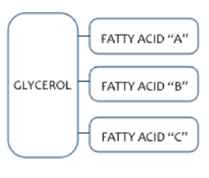 Come è fatto un Omega-3
 Lo standard GOED (Global Organization For EPA and DHA) è un ottimo standard. Lo standard IFOS (International Fish Oil Standards) è un altro ottimo standard
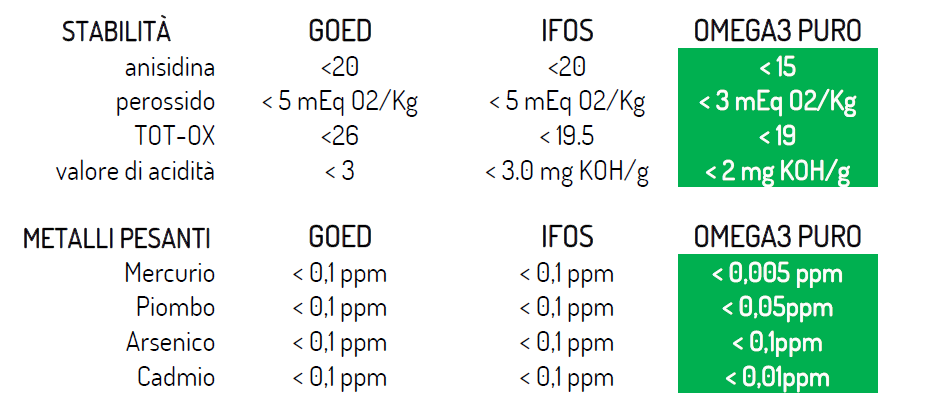
 Da ultimo, ma non per importanza, anche la certificazione Friends Of The Sea®, ha un suo valore: attingere da pescherie sostenibili che non impoveriscono l’oceano è un dovere per la salute del nostro ambiente e della fauna marina. La fonte ottimale di Omega 3 è infatti proveniente da acciughe e sardine, che hanno un ciclo riproduttivo velocissimo, non rischiano estinzione e risiedono nelle profondità oceaniche, dove l’acqua è più pura.


